

Listen to the article
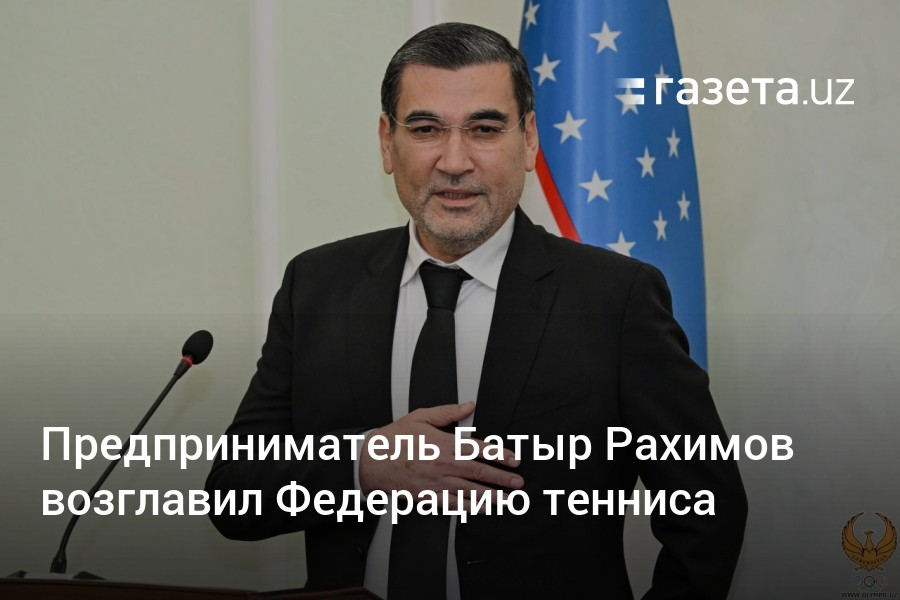
Batyr Ikramjanovich Rakhimov, the entrepreneur who founded Kapitalbank in 2001 and previously served as president of football club Pakhtakor, was elected chairman of the Uzbekistan Tennis Federation on 17 February 2025 at an extraordinary elective conference held at the National Olympic Committee in Tashkent.
The appointment was one of three leadership changes confirmed that day across Uzbek sporting bodies, with representatives of the Ministry of Sport and Otabek Umarov, first deputy head of the NOC, in attendance. Rakhimov succeeds Alisher Mirsоatov, chairman of the board of the National Bank of Uzbekistan, who simultaneously moved to lead the newly restructured Association of Winter Sports—a lateral shift that itself illustrates the revolving-door character of Uzbekistan’s sports governance landscape.
A Business Empire Behind the Appointment
Beyond Kapitalbank, which he established more than two decades ago, Rakhimov is described by the Ministry of Sport’s press service as the founder of numerous companies operating across finance, insurance, consumer goods manufacturing, construction and the food industry. The breadth of that portfolio places him among a relatively small cohort of Uzbek entrepreneurs with diversified holdings spanning multiple regulated sectors—a profile that has historically attracted scrutiny in post-Soviet economies where business licences and state contracts can intersect with institutional influence.
His earlier tenure as president of Pakhtakor, Uzbekistan’s most prominent football club, gave him prior experience navigating the intersection of sport administration and business interests, though the source does not specify the dates or outcomes of that role.
Family Connections to the First Family and the Usmanov Network
The appointment carries an additional layer of public interest because of Rakhimov’s family ties. He is married to Diyora Usmanova, described in the Gazeta.uz report as the widow of Babur Usmanov—a nephew of Russian billionaire Alisher Usmanov—and as a niece of Ziroat Mirziyoyeva, the first lady of Uzbekistan. Neither connection constitutes evidence of impropriety, and the source makes no such allegation. However, in a governance environment where transparency around appointments to publicly recognised sporting bodies remains limited, the convergence of elite business interests and close proximity to both the presidential family and a prominent international business dynasty is a fact that warrants noting in any accountability record.
Uzbekistan has in recent years sought to professionalise its sports federations and attract private-sector leadership, partly in preparation for major international competitions. Officials at the 17 February conference set out priorities including preparation for the 2026 Winter Olympics in Milan and Cortina d’Ampezzo and the 2028 Summer Olympics in Los Angeles.
Governance Questions Left Open
The source does not disclose whether Rakhimov’s election followed a competitive nomination process, what governance or conflict-of-interest rules apply to federation chairmanships in Uzbekistan, or whether his business interests intersect with any federation contracts or sponsorship arrangements. It also does not address whether Kapitalbank or his other companies hold any commercial relationship with the NOC, the Ministry of Sport or affiliated bodies. These are standard accountability questions that apply to any senior business figure assuming a publicly recognised institutional role, and they remain unanswered on the available record.
No statement from Rakhimov himself was included in the Ministry of Sport’s announcement, and no independent comment or response is contained in the source material.