

Listen to the article
Preparations to privatise Uzbekistan GTL — the country’s most expensive industrial facility, built at a cost of at least $3.42 billion — are formally under way, but the agency leading the process has yet to disclose the plant’s current financial performance, and a criminal trial involving its former supervisors continues behind closed doors.
The State Assets Management Agency (SAMA) confirmed at an 8 October press conference that a privatisation concept for the gas-to-liquids plant has been drawn up. SAMA chief Sohibjon Murodov said preparatory work is now focused on assessing the plant’s financial and operational condition, identifying problems, and analysing the likely consequences of a change of ownership. He was careful to frame the announcement narrowly. “The privatisation stage has begun, in a certain sense,” he said. “That does not mean it will be sold within a set period — it means work on privatisation begins within that period.”
A presidential decree of 21 April 2025 had ordered the full 100 percent stake in Uzbekistan GTL — then owned by state energy company Uzbekneftegaz — to be privatised, with preparatory measures to start in the third quarter of 2025 and an open auction to be announced in the second quarter of 2026. By October 2026 the plant had not yet been put up for sale.
SAMA is also examining the possibility of an initial public offering. Murodov said large international organisations had already approached the agency expressing interest in participating in an IPO and acquiring minority stakes. No terms, no proposed share size, and no IPO timeline have been announced.
A Debt Load That Is Only Partly Visible
When asked directly about the plant’s current finances and how much of its debt had been repaid, Murodov acknowledged he did not have the figures to hand. “Regarding financial activity, frankly, I do not have direct information,” he said, promising to publish current financial indicators through SAMA’s social-media channels separately.
What is publicly known comes from Uzbekistan GTL’s own website. As of 16 June 2026, the outstanding principal on the plant’s foreign loans stood at $838.2 million. Since repayments began, approximately $1.46 billion — or 63.6 percent of the original loan principal — has been repaid. The largest remaining creditor is China Development Bank, which is owed $483.6 million of an original $1.2 billion loan. South Korea’s Export-Import Bank (KEXIM) is owed $201.5 million; loans covered by the Korean trade insurer K-SURE carry a remaining balance of $112.8 million; and a further $40.3 million remains on KEXIM-guaranteed facilities.
Russian creditors have been fully repaid. A $120 million loan from Gazprombank and a $100 million loan from Russia’s export-import bank — subsequently acquired by Gazprombank — were both retired early on 28 February 2023. In 2025 the creditor roster shifted further: the Singapore branch of KEB Hana Bank acquired part of the KEXIM-guaranteed debt and a $30 million K-SURE-covered loan, while MUFG Bank’s London branch took over claims that had belonged to Credit Suisse, later absorbed into UBS.
Those figures cover outstanding principal only. They do not capture accrued interest or other contractual obligations — and they exclude a structurally distinct long-term commitment to the American industrial-gas company Air Products.
In May 2023 the Uzbek government and Uzbekneftegaz signed a $1 billion agreement under which Air Products purchased the plant’s industrial-gas production assets — including air-separation units and synthesis-gas and hydrogen equipment — and undertook to operate them and supply the gases the plant requires. The deal runs for 15 years, with Uzbekistan retaining the right to buy the assets back at the end of the term. Air Products receives a fixed monthly payment regardless of whether the full volume of output is needed. The company classifies the arrangement as a financial transaction rather than a straightforward asset sale; as of 30 September 2025 it carried a financial receivable of approximately $1 billion related to the deal on its books. Any prospective buyer of Uzbekistan GTL will inherit this long-term payment obligation alongside the residual bank debt.
Defects, a Reduced-Capacity Plant, and a Criminal Trial
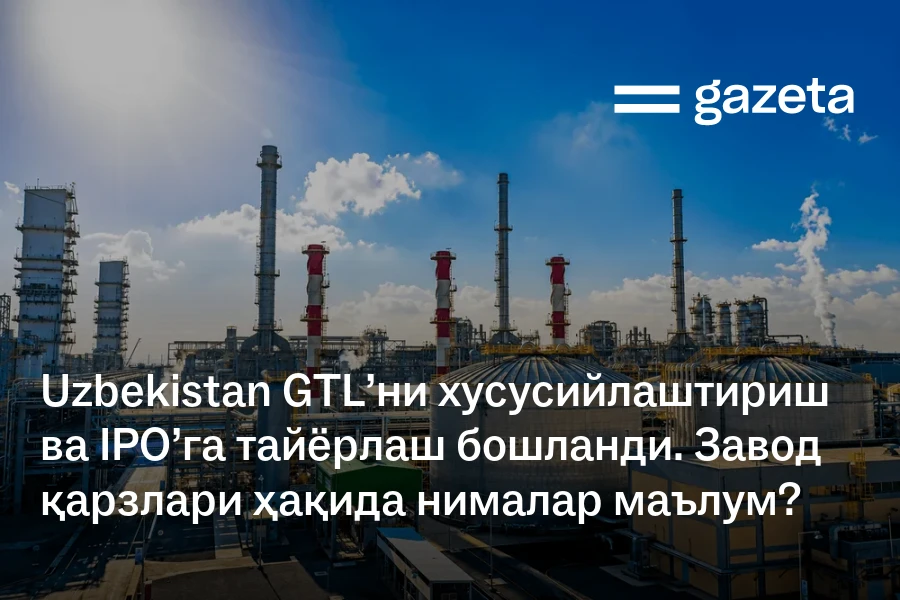
The plant, located in Qashqadaryo region near the Sho’rtan gas-chemical complex and inaugurated by President Shavkat Mirziyoyev in December 2021, uses gas-to-liquids technology to convert natural gas into liquid petroleum products. Its design capacity is 3.6 billion cubic metres of gas per year, yielding 724,000 tonnes of diesel, 307,000 tonnes of aviation kerosene, 437,000 tonnes of naphtha, and 53,000 tonnes of liquefied gas annually.
In practice the plant ran well below that capacity for years. A trial that opened in Tashkent in July 2026 has shed some light on why. The defendants include Bahodir Sidiqov, the former chairman of Uzbekneftegaz, and eight others. One strand of the case concerns the plant’s relationship with Air Products and with the construction contractor Enter Engineering.
At a hearing on 31 July, Sidiqov told the court that more than 2,400 defects and shortcomings were identified after construction was completed, including roughly 50 serious faults in three core units — among them the air-separation equipment. As a result, he said, the plant operated at approximately 72 percent of capacity. He added that failure to meet performance benchmarks written into the loan agreements had created the risk of an accelerated repayment demand of nearly $2.4 billion; because the Ministry of Economy and Finance had acted as guarantor, that liability would have fallen on the state.
To resolve the situation, Sidiqov said, Air Products was brought in. The American company agreed to finance the cost of remedying the defects, with the contractor Enter Engineering to reimburse those costs subsequently. His former deputy, Baxtiyor Anarqulov, specified that the repairs over three years cost approximately $56 million. A separate dispute concerns a payment of approximately $21.4–21.8 million that Uzbekneftegaz made to Air Products in place of Enter Engineering under warranty obligations. Sidiqov argued that settling with Air Products was necessary to preserve the project and maintain the confidence of international investors. None of the defendants has admitted guilt. In August the proceedings moved into closed session.
Uzbekneftegaz announced in December 2025 that the plant had finally reached full capacity — four years after commissioning. At an internal meeting at the time, then-chairman Abdug’ani Sanginov criticised problems that had persisted for years: technological deficiencies had not been fully resolved and unplanned shutdowns continued, both of which had weighed on the plant’s financial stability. Management was tasked with analysing the causes of unplanned stoppages, eliminating technological risks, and increasing output by 15–20 percent in 2026, while also finding additional natural-gas feedstock without cutting domestic supply.
The plant’s troubled operating history had already drawn the attention of credit-rating agencies. S&P downgraded Uzbekneftegaz from BB− to B+ in late 2023, citing the company’s high debt burden and the GTL plant’s below-capacity performance, before raising the rating again in 2025.
As privatisation preparations advance, several material questions remain unanswered: the plant’s current profitability, the full scope of its contractual obligations, the stability of its operations, and the terms on which a future investor would acquire it. SAMA has promised to publish financial data; it has not yet done so.