

A public-private partnership agreement to build and operate a new international airport for the Tashkent region was signed on June 17, 2026, on the sidelines of the 5th Tashkent International Investment Forum — moving a project that began with a ceremonial groundbreaking eight months ago into the realm of contractual obligation.
The agreement was concluded between state-owned Uzbekistan Airports and an international consortium led by Saudi Arabia’s Vision Invest, which holds a 45% stake. Japan’s Sojitz Corporation takes 30%, South Korea’s Incheon International Airport Corporation holds 15%, and Uzbekistan Airports retains the remaining 10%. The private partner will manage the facility for 35 years, running to approximately 2065.
What Is Being Built — and Who Pays for What
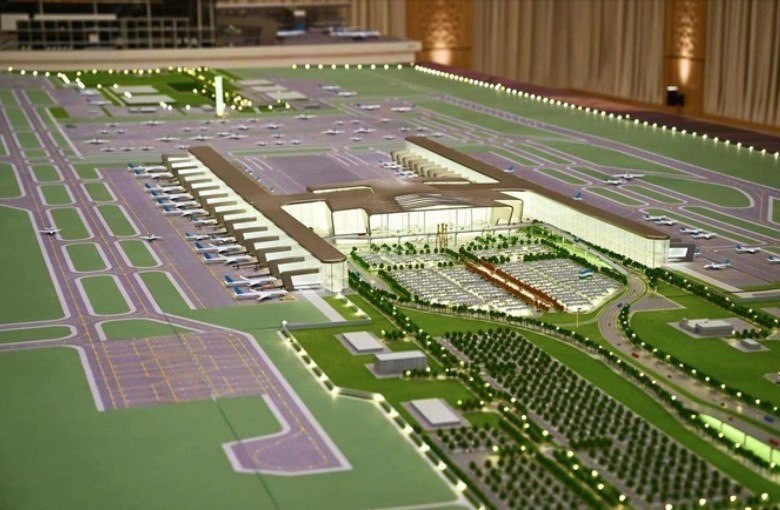
The airport will occupy a 1,310-hectare site in the Urtachirchik and Kuyichirchik districts of the Tashkent region. The first phase, authorised by Presidential Resolution No. 353 of November 25, 2025, covers two four-kilometre runways, a 208,000-square-metre passenger terminal, 98 aircraft parking stands, a fuel complex, and an air traffic control tower. Construction runs from 2026 to 2030, with commissioning planned for late that year.
The division of financial and operational responsibility is clearly drawn. The private consortium is responsible for the passenger terminal and forecourt. The state retains responsibility for airfield infrastructure — runways and taxiways. First-phase costs are estimated at $2.5 billion, with the project expected to attract around $3 billion in total foreign direct investment.
At full first-phase capacity the airport will handle up to 20 million passengers and 129,000 tonnes of cargo a year, support 30 aircraft movements per hour, and accommodate 62 aircraft simultaneously. In its long-term configuration the terminal will be four times the size of the existing Tashkent airport and capable of serving up to 46 million passengers annually, served by more than 40 jet bridges and 160 aircraft stands.
Why the Existing Airport Cannot Simply Be Expanded
The urgency is arithmetical. Passenger traffic through Tashkent has tripled over the past eight years to nine million a year and is forecast to reach 24 million by 2040. The current airport was designed for a maximum of 11 million passengers and sits inside city limits, ruling out any meaningful expansion. It is projected to hit full capacity by 2029 — the year before the new facility is due to open — after which it is expected to close.
President Shavkat Mirziyoyev attended the ceremonial groundbreaking in October 2025, signalling the political weight attached to the project. Environmental and social impact assessments in line with international financial institution requirements were completed before the June signing, alongside plans for relocating engineering utilities; site preparation has already begun.
A Regional Transport Hub, Not Just an Airport
The new facility is conceived as part of a broader transport node. It will connect directly to the Tashkent–Samarkand toll highway and to routes serving Andijan and Bostanliq. A dedicated high-speed rail station will be built on site, and shuttle services will link the new location to the capital. The airport has also been presented as the first in Central Asia to be built according to green construction principles, though the specific standards underpinning that claim were not detailed in the agreement documents.
The Tashkent project sits within a wider national aviation push. Uzbekistan’s Ministry of Economy and Finance fiscal strategy for 2026–2028 includes plans to begin construction of new international airports in Bukhara and Urgench this year, as part of a target to increase domestic air travel by at least 50%.
With investors assigned defined equity shares, responsibilities split between public and private parties, and a four-year construction schedule now locked in, the project has cleared its most visible procedural hurdles. Whether it meets its 2030 commissioning deadline — and whether the state delivers airfield infrastructure in step with the consortium’s terminal work — will be the practical measure of whether the partnership holds.
