
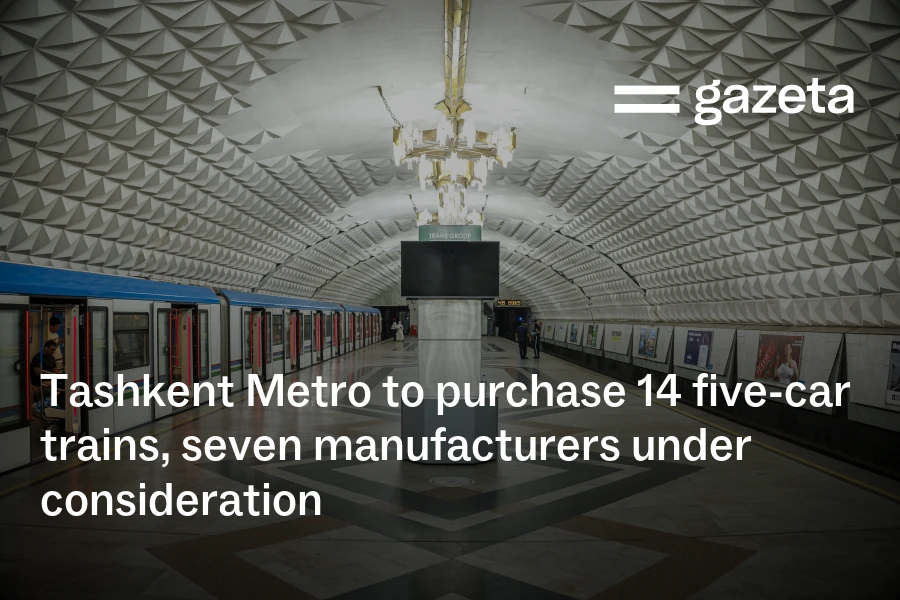
Tashkent’s city council has approved a concept for purchasing 14 five-car trains — 70 cars in total — for the capital’s metro system, with completion targeted by the end of 2027 and financing to be drawn from foreign governments and international financial institutions. The kengash, Tashkent’s deputies council, gave its approval on 8 October.
The procurement is framed as part of a broader effort to expand metro capacity, phase out ageing rolling stock and reduce operating costs, including electricity and maintenance expenditure. The system currently carries an average of more than 800,000 passengers a day across four lines spanning 70 kilometres and 50 stations; in late September daily ridership briefly exceeded 1.2 million, a record for the network.
Why five cars, not six
Planners considered six-car configurations during the concept’s development but concluded that existing station lengths cannot accommodate them. Extending platforms would require substantial capital investment, making the five-car format the practical ceiling without a separate infrastructure programme. The metro currently runs only four-car trains. A trial in early 2023 added a fifth car to four trains on the Uzbekistan Line, lifting per-train capacity from roughly 1,000 to 1,300 passengers, but the expansion was not rolled out further.
The new trains would represent a significant technical step up from the Soviet-era 81−717/714 models still in service. Each new car would be fitted with 170 kW asynchronous traction motors, compared with the 110 kW direct-current motors on the older stock. Seating would run to 40 places in lead cars and 44 in intermediate cars, with standing capacity of between 176 and 330 passengers per car depending on configuration.
Seven manufacturers, two commercial proposals
The concept evaluated seven international suppliers on supply cost, financing terms and their ability to provide depot and maintenance facilities: CRRC of China, Japan’s Kawasaki Rail Car, Spain’s CAF, France’s Alstom, Russia’s Global Transport Solutions, the Czech Republic’s Škoda Transportation and South Korea’s Hyundai Rotem. Of those, only CRRC and Global Transport Solutions submitted commercial proposals. Germany’s Siemens assessed the tender and concluded its products did not meet Tashkent Metro’s requirements, declining to bid.
The concept singles out CRRC, Global Transport Solutions and Hyundai Rotem as the most suitable options. Selecting the Russian manufacturer, the document notes, would avoid the need to reconstruct existing depots and infrastructure — an advantage given the compatibility of post-Soviet rolling stock with legacy facilities — but the overall project cost would be higher because of interest payments attached to the associated loan financing.
The financing structure, which relies on attracting foreign government and institutional funding, means the choice of supplier is likely to be intertwined with the terms offered by each country’s export-credit or development-finance mechanisms, a dynamic that frequently shapes large rail procurement decisions across Central Asia.
