
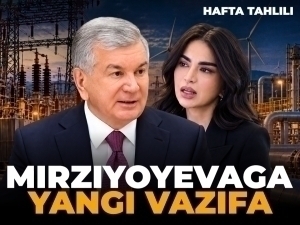
President Shavkat Mirziyoyev signed into law sweeping amendments to five codes and six statutes this week, introducing life imprisonment for sexual violence against children under 14 and removing any statute of limitations for such offences. The legislation followed a high-profile case in which the warehouse manager of a kindergarten in Namangan was accused of raping a five-year-old girl in his care.
Under the amended Criminal Code, individuals convicted under Articles 118 and 119 — covering rape and violent sexual acts against children under 14 — face either 25 years’ imprisonment or life imprisonment when aggravating circumstances are established. The same maximum penalties apply to premeditated murder and terrorism under equivalent aggravating conditions. A sentence of 20 to 25 years, previously unavailable in the code, is now reserved specifically for the most serious offences in those categories. Separately, the Code of Criminal Procedure was amended to guarantee state-funded legal representation for underage victims and witnesses in sexual violence cases.
The law also stiffened penalties for involving minors in alcohol or drug use. Fines for a first administrative offence followed by a repeat criminal act rise from a band of 100–200 times the base rate to 150–250 times, equivalent to roughly 66 million and 110 million soums respectively at the upper end. Mandatory community service increases to up to 400 hours, and the maximum custodial sentence for drawing minors into narcotics consumption rises from three to five years in standard cases, and from five to seven years. Where the offence is repeated, involves two or more minors, occurs on school premises, or results in death or other grave consequences, the sentence rises to seven to ten years — up from a previous ceiling of ten years that applied only to the most aggravated circumstances.
Heating Tariffs to Rise 30% from November
Separately, the Cabinet of Ministers published a draft resolution on 13 October proposing a 30% average increase in district heating and hot water tariffs, effective 1 November. The draft, released for public comment, also proposes raising the price of bottled liquefied gas from 2,000 soums per kilogram to 5,000 soums per kilogram. Vulnerable households consuming up to 20 kilograms per month would receive a compensation payment of 3,000 soums per kilogram, effectively keeping their net price at 2,000 soums. A total of 158 billion soums has been earmarked for that subsidy.
For households in areas without gas connections or where natural gas supply is difficult, the draft proposes raising the baseline electricity allowance from 200 kilowatt-hours per month to 350 kilowatt-hours during the heating season, starting 1 November 2026. Electricity consumed in the 201–350 kWh band would be billed at 650 soums rather than the current 900 soums — a reduction of roughly 28% for that tranche. The heating season is defined as October through February in Karakalpakstan and Khorezm, and November through February elsewhere.
The package also proposes a one-off payment of 1 million soums to vulnerable families in November 2026, an expansion of the eligibility criteria for electricity and gas compensation to cover an additional 166,000 households, and an extension of above-baseline consumption subsidies from April 2027 to April 2028 — a measure that would benefit 470,000 families at an additional cost of 150 billion soums.
Energy Sector Overhaul and a New Investors’ Council
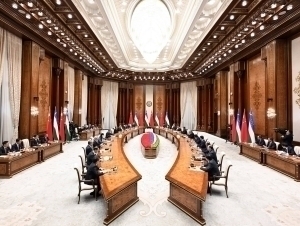
The tariff changes sit within a broader energy reform agenda that President Mirziyoyev outlined at an open dialogue with major foreign investors in the fuel and energy sector this week. Participants included large private companies from Saudi Arabia, Turkey, Azerbaijan, the United Arab Emirates, China and Oman. The president set a target of 22,000 megawatts of new generating capacity by 2030, which he said would push annual electricity output above 129 billion kilowatt-hours and lift the share of renewable energy to 54%. The plan also envisages constructing 5,000 kilometres of transmission lines and 16 large substations, and building energy storage capacity of 4.5 gigawatts.
Six solar and wind projects with a combined capacity of 2,200 megawatts are to be put to open tender shortly. The government announced it would publish the country’s first National Master Plan for the energy sector through 2050, with a grid connection opportunity map due by 1 March next year and the full master plan by 1 July. A new Investors’ Council for the fuel and energy sector is to be established, to be chaired by Presidential Administration head Saida Mirziyoyeva. The president described the council as a mechanism for building genuine partnership with investors rather than attracting capital alone.
Defense Minister Dismissed; Tashkent Governors Reshuffled
The week opened with the abrupt dismissal of Defense Minister General-Major Shuhrat Xolmuhammedov, who had held the post since November 2024. The president’s press secretary, Sherzod Asadov, attributed the departure to a transfer to other duties, though no specific new appointment had been announced by the end of the week. His successor is Botir Qudratxo’jayev, who served as Military Prosecutor from 2022 to 2025, then as Minister of Emergency Situations for one year, and most recently as First Deputy Minister of Internal Affairs and head of the Operational Investigation Department since January of this year.
Four district governors in Tashkent city were also replaced. Saidqahhor Xolxo’jayev of Chilonzor, Baxtiyor Rahmonqulov of Yashnobod, Hayot Inog’omov of Yangihayot, and Nilufar Allaberganova of Yakkasaroy all left their posts. Allaberganova, described as having a background rooted in the prosecutor’s service, was appointed deputy city prosecutor of Tashkent on the same day. Rahmonqulov was moved to head the inspectorate of the Ministry of Emergency Situations. Their replacements are: Abdulaziz Abdulhaqov in Yashnobod; 37-year-old Lazizbek Temirov in Yangihayot; 40-year-old Hayot Inog’amov in Chilonzor; and 39-year-old Akmal Jumaboyev in Yakkasaroy.
In a separate regional change, Doniyor Qodirov — head of the Public Security and Rule of Law Department in the Presidential Administration — was appointed governor of Syrdarya region, filling the vacancy left when Erkinjon Turdimov moved to the post of First Deputy Prime Minister and Minister of Education and Science.
Deputy Governor Arrested for $25,000 Bribe
A deputy governor of Tashkent district in Tashkent region was detained this week after being caught accepting $25,000 in cash. According to investigators, the official had promised a businessman that he would arrange the auction of a one-hectare plot of land on the district administration’s balance sheet — land the businessman wanted for a construction materials and composite door manufacturing complex. The official told the businessman he would resolve the matter through contacts at the State Assets Management Agency and demanded $25,000 in return.

Officers of the State Security Service’s Tashkent region directorate detained the official at the moment he received the money, with material evidence secured. Criminal proceedings have been opened under Article 168, Part 4(g) of the Criminal Code — fraud — and under Articles 28 and 211, Part 3(a) — bribery, including provisions on forms of criminal participation. The investigation is ongoing.
Odilxon Ismoilov Released on Suspended Sentence
Islamic scholar Odilxon Ismoilov, who had been sentenced in July of this year to eight years’ imprisonment under Article 167, Part 3(a) of the Criminal Code — misappropriation or embezzlement — was released from custody this week after an appellate court in Namangan region reviewed his case. The Namangan Regional Court’s appellate chamber issued its ruling on 12 October. The court found that part of the damages established in the original case had been repaid in cash to a deposit account, that property belonging to Ismoilov had been accepted onto a bank balance and that seized assets had been sold and proceeds directed toward compensation, and that property belonging to Ismoilov and close relatives had also been applied to the damages. On that basis, the original eight-year sentence was left unchanged in its legal classification but converted to a three-year suspended term under Article 72 of the Criminal Code.
Kazakhstan Introduces Electronic Entry Permits for Uzbek Citizens
Kazakhstan announced this week that it is introducing an electronic entry authorisation system for foreign nationals, including citizens of Uzbekistan, who currently travel under a visa-free arrangement. The new rules take effect on 24 October this year, though the permit will not become mandatory until July 2027. During the transition period, absence of a permit will not constitute grounds for refusing entry. Applications must be submitted at least 72 hours before travel via a digital platform; the permit is free of charge and valid for 180 calendar days. Exemptions cover children under 16, persons over 65, holders of valid Kazakhstani visas or residence permits, certain diplomatic categories, and members of official delegations. Visa-free visitors may stay up to 30 days per visit, with a total of no more than 90 days within any 180-day period; citizens of Eurasian Economic Union member states may stay up to 90 days within a 180-day period.
