

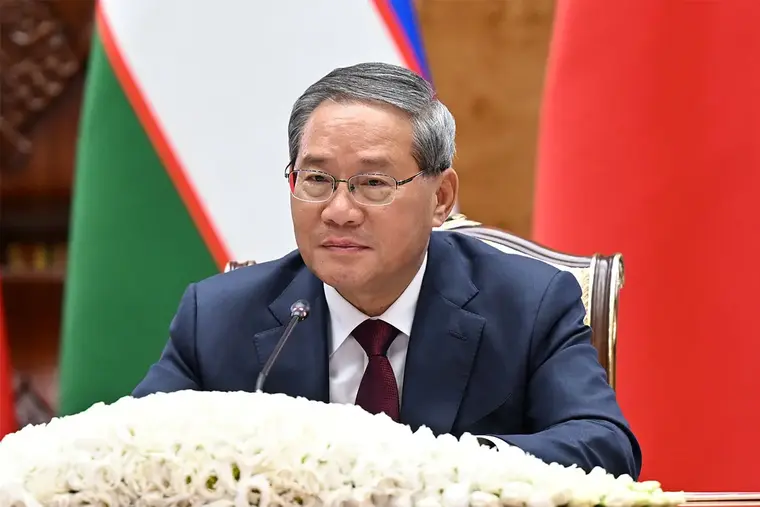
Chinese Premier Li Qiang arrived in Tashkent on 17 October 2026 for an official visit that placed bilateral trade expansion and a long-anticipated regional railway project at the centre of the agenda. Li held separate meetings with President Shavkat Mirziyoyev and Prime Minister Abdulla Aripov, using both sessions to outline Beijing’s readiness to deepen economic ties with Uzbekistan across several strategic sectors.
At his meeting with Mirziyoyev, Li reaffirmed China’s commitment to ensuring high-quality implementation of the China-Kyrgyzstan-Uzbekistan (CKU) railway — a connectivity project that would give landlocked Uzbekistan a direct rail corridor to Chinese markets without routing through Russian territory. No revised construction timeline was announced, but the explicit reaffirmation at head-of-government level signals continued political backing from Beijing for a project that has faced prolonged negotiations over financing and route alignment.
In talks with Prime Minister Aripov, Li said Beijing was prepared to purchase larger quantities of high-quality and specialised Uzbek products, though no specific volume targets, commodity categories or trade-balance commitments were disclosed. China also encouraged Uzbekistan to make greater use of the China International Import Expo and other state-backed platforms to promote domestic goods and secure broader access to the Chinese consumer market.

Sectors Identified for Deeper Cooperation
Li told both sides that China was ready to coordinate development strategies and expand cooperation in energy, natural resources, artificial intelligence and modern agriculture. The pairing of AI and agriculture reflects a pattern visible in other Chinese bilateral agreements across Central Asia, where precision farming technologies and data-driven irrigation systems have been offered alongside more conventional resource partnerships. No specific projects, investment sums or joint-venture structures were announced during the visit.

On investment conditions, Li said China supports the entry of Chinese companies into the Uzbek market and expressed hope that Tashkent would continue creating favourable conditions for business operations and investment projects. The formulation is a standard feature of Chinese diplomatic communiqués but carries practical weight given the scale of Chinese capital already present in Uzbekistan’s mining, construction and manufacturing sectors.
Context: Trade Imbalance and Export Diversification
The visit comes as Uzbekistan actively seeks to diversify its export markets and reduce structural trade imbalances with major partners. China is already one of Uzbekistan’s largest trading partners, but the relationship has historically been weighted toward Chinese exports — machinery, electronics and consumer goods — flowing into Uzbekistan rather than the reverse. A credible Chinese commitment to increase imports of Uzbek products, if followed through, would represent a meaningful shift in that dynamic. The CKU railway, once operational, would reduce transit costs and times for Uzbek exporters reaching Chinese ports, making the trade pledge more commercially viable.
Specific details on which Uzbek product categories China intends to prioritise, what investment volumes are envisaged for the identified sectors, and when the next construction phase of the CKU railway is expected to begin were not made public following the meetings. Xinhua, cited as the source for Li’s remarks, reported the visit without disclosing a joint communiqué or signed agreements.
